
An Open Letter to Jon Stewart on Economics, Incentives, and the Motte You Built Yourself
How a comedian proved the discipline right by trying to prove it wrong


“It is difficult to get a man to understand something when his salary depends upon his not understanding it.”
—Upton Sinclair
Dear Jon,
Let me begin by laying out, as plainly as I can, what happened over the past two weeks and why many economists reacted the way they did, because I think you deserve a fair account before I explain where I believe the reasoning went wrong.
You invited Richard Thaler onto your show. Thaler is a Nobel laureate whose entire career has been dedicated to a single, elegant observation, namely that real people do not behave like the perfectly rational agents of introductory textbook models, and that economic analysis and public policy should account for this. He came on to explain that subfield, behavioral economics, which is, if you think about it for even a moment, the most sympathetic possible response to every populist frustration you have ever voiced about the discipline. The man who showed up at your door was carrying the answer to the question you have been asking for thirty years. But rather than letting him explain how the field already incorporates the messiness of real human behavior, you spent the conversation lecturing him on what you believe economics to be, which is, in your words, a system whose goal is to make the most amount of money for shareholders. Thaler, visibly patient, tried to redirect. He explained that economists overwhelmingly favor a carbon tax to address climate change, which is about as far from a shareholder-enrichment scheme as a policy recommendation can get. You rejected it, not on analytical grounds, but because you felt it would be politically unpopular. And then, minutes later, you proposed what Thaler gently pointed out was essentially the same thing.
Economists noticed, and they were not kind about it. You were, by your own admission, surprised. You told your producers you had no idea what you had stepped in. And your response to that criticism was not to revisit the substance but to bring on Oren Cass, a man whose title of Chief Economist was obtained by founding an organization and giving the title to himself, which is a bit like responding to a bad medical diagnosis by consulting someone who printed his own diploma.
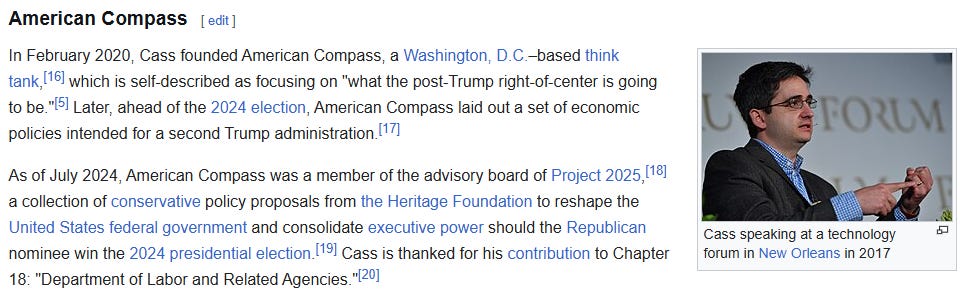
Cass, who has his own reasons for wanting the discipline discredited, happily agreed with everything you said and introduced you to the concept of a motte-and-bailey argument, which he explained economists use to make sweeping policy claims and then retreat to the defense that they are merely doing “neutral science” whenever anyone pushes back. You loved this framing. You even joked, at one point, that you have your own motte and bailey, and Cass told you that you were misusing the term. But you were not misusing it. You were describing exactly what you do, and have done, for decades.
Now, economists love mathematical modelling because it forces you to be transparent about every assumption you make and every conclusion you draw from them. Here we will do something similar using formal logic, which is like math but without the numbers. We state your premises, derive your conclusions step by step, and then check whether the deduction is valid and whether the premises are sound.
(P1) Economists sometimes advise policymakers.
(P2) Some policies produce bad outcomes.
(P3) If a group advises on a process, that group’s field is identical to that process.
(S1) From P1 and P3: economics is identical to policy.
(P4) Policy is made through politics.
(S2) From S1 and P4: economics is identical to politics.
(S3) From P2 and S1: economics produces bad outcomes.
(P5) If something produces bad outcomes, its purpose is to produce bad outcomes.
(S4) From S3 and P5: the purpose of economics is to produce bad outcomes, specifically to enrich shareholders at the expense of everyone else.
The deduction is valid. Each step follows from the steps before it. The problem is not the logic but the premises.
P1 is true. Economists do advise policymakers.
P2 is true. Some policies do produce bad outcomes.
P3 is false.
Advising on a process does not make your field identical to that process. Climate scientists advise governments on emissions policy, but climatology is not the same thing as emissions regulation. Military historians brief defense officials, but historiography is not the same thing as foreign policy. And you yourself proved P3 false in the same conversation, because when Thaler told you that economists recommend a carbon tax and you replied that it would be politically unpopular, you identified the exact mechanism by which economic advice and political outcomes come apart. The economist recommends, the politician declines for electoral reasons, and bad policy follows not from the discipline but from the political incentive structure that determines which insights get adopted and which get discarded. You are holding the proof in your hand and reading it upside down.
P4 is true, or at least close enough.
P5 is false.
This is the move from “produces” to “is designed to produce,” from correlation to teleology. Doctors advise on health policy, some health policy produces bad outcomes, but nobody concludes that the purpose of medicine is to make people sick. Engineers worked on the Titanic, but naval architecture is not a pro-drowning ideology.
The argument rests on two hidden premises, P3 and P5, which you never state out loud because stating them out loud would make it immediately obvious that they are wrong. That is, in a sense, how all bad arguments work. The steps you say explicitly are true, the steps that do the actual work are kept implicit, and the conclusion feels like it follows naturally because nobody stopped to check what was holding it up.
Economics, at its core, is the study of how people make decisions under constraints. That is all it is. It is not an ideology, it is not a political program, and it is not a conspiracy to funnel wealth upward. It is a set of tools for understanding how individuals, firms, and governments respond to incentives, trade-offs, and scarcity. Sometimes those tools get applied well and sometimes they get applied badly, just as medicine sometimes cures and sometimes harms, but nobody concludes from the existence of malpractice that the goal of medicine is to kill patients.
Now, about that motte and bailey. When Cass explained the concept, he described economists spreading out into bold policy claims and then retreating to the defensible position that they are merely doing science when challenged. But consider who is actually running that play here. Your bailey, the expansive claim you spread out into, is that economics as a discipline is a corrupt enterprise designed to immiserate workers and enrich shareholders. Your motte, the fortified position you retreat to whenever someone with actual expertise pushes back, is that you are just a comedian having spirited conversations and that the real problem is that economists are mean. You have been executing this maneuver for thirty years across every domain you have ever opined on, and Cass, who was there to validate rather than challenge, did not notice because it was not in his interest to notice.
It would be genuinely wonderful if you decided to change course. It would be wonderful if the next time you sit across from an economist (or any expert) you let them finish a sentence before telling them what their own field is about. This is not a new problem. You did it to 78th United States Secretary of the Treasury and former Fed Chair Janet Yellen, whose academic work on efficiency wages and labor market rigidities helped build the New Keynesian framework that is now the standard workhorse of macroeconomic policy analysis, when she tried to explain fiscal policy on your Apple TV show:
You did it to Christine Lagarde, the former IMF Managing Director, former French Finance Minister, and current President of the European Central Bank, when she came on The Daily Show to talk about inflation and the global economy:
You did it to Jason Furman, Obama’s chief economic advisor and a Harvard professor so mild-mannered that he almost never raises his voice, who afterwards described his appearance on your show as the single worst interview of his career and worried that he had done more to convince your audience that economists are obnoxious than that they have useful insights.

There is a pattern here, Jon, and the common variable across all of these encounters is not the discipline of economics.
But I want to be honest about what I think would actually have to change for you to engage differently, and this is where, ironically, economics has something to teach us about you. We can think about your relationship with your audience, your ignorance, and your career as a straightforward incentive problem, an economic game. Your listeners reward confident moral outrage directed at powerful-sounding targets. They do not reward careful distinctions between what economists study and what politicians choose to do with those findings. The payoff of letting an expert explain something complicated and then saying “huh, I learned something today” is low, because that is not the show people tuned in to watch. The payoff of interrupting a Nobel laureate to say that economics is just about making rich people richer, and then bringing on someone with no credentials who agrees, is high, because that is exactly the show people tuned in to watch. This is the same logic you yourself identified when you rejected the carbon tax. Politicians do not implement good policy because their incentives point elsewhere. You do not engage with good arguments because your incentives point elsewhere. The very thing that explains bad policy outcomes, namely that political actors respond to their own constraints rather than to the best available analysis, also explains why you will probably keep doing what you are doing.
None of this is said with hostility. Economics is, at bottom, just the study of how people make decisions when they face constraints and trade-offs, and you are a person facing constraints and trade-offs. Your constraint is that your career depends on an audience that wants you to be outraged, not informed. Your trade-off is between the short-run reward of telling millions of people what they already believe and the long-run cost of making those same people less equipped to evaluate the policies that affect their lives. I genuinely hope you surprise us all and choose differently. But economics, the field you insist has nothing useful to say, would predict that you will not.